Gravel off.
Foam down.
Silicone on.
For suitable roof assemblies, a coordinated approach to gravel ballast removal, closed-cell roofing foam, and a protective silicone top coat.
Discuss roof restoration ↗Talk directly with the owner. Call 940-297-1652.
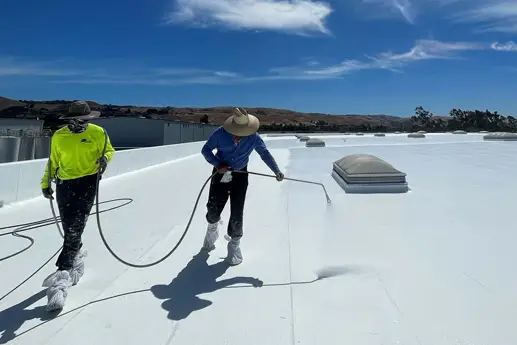
One coordinated plan.
From ballast to top coat.
Restoration begins with suitability. Gravel removal, substrate preparation, foam, and coating must work together as a complete roof assembly.
Evaluate
Check moisture, deck condition, existing assembly, attachment, and drainage.
Remove & prepare
Remove ballast as specified. Address wet or unsound materials and prepare a suitable surface.
Apply roofing foam
Install the specified closed-cell roofing foam with attention to drainage and roof details.
Protect with silicone
Apply the compatible protective coating and complete the final inspection.
Ballast can be part of a roof's wind resistance. Removal and the new assembly must be evaluated together.
Continuous insulation.
Seamless protection.
Roofing-grade spray polyurethane foam forms a continuous insulating layer on a suitable substrate. A compatible silicone top coat protects the foam from weather and ultraviolet exposure.
Preparation, application thickness, roof details, coverage, and ongoing maintenance all matter.
Evaluate your roof first ↗Keep business moving.
Plan the work carefully.
Our goal is to minimize disruption. We coordinate the scope with you before crews and equipment arrive.
A plan for
people and equipment.
Coordinate access points, equipment locations, work areas, and facility traffic.
Think through
the surroundings.
Discuss application areas, weather windows, adjacent property, and operational requirements.
Know what
to expect.
Review scheduling and any necessary temporary restrictions before work begins.
Before you decide.
Have a different question? Call and tell us about your building.
Can every gravel roof be converted to foam and silicone?
No. Moisture, deck condition, attachment, substrate compatibility, wind resistance, and the existing assembly must be evaluated. Gravel removal alone does not establish suitability.
Does a silicone top coat solve drainage problems?
No. A properly selected silicone system can tolerate ponding exposure within its manufacturer’s requirements, but drainage defects still need their own evaluation and correction.
Let's put a plan
over your business.
Start with a direct conversation about your commercial roof.